
The Visibility Was Already Working. They Just Didn't Know It Yet.
The quiet signs your marketing is beginning to work.
Estimated reading time: 7 minutes
One of the questions I hear most often from small business owners is surprisingly simple:
"How do I know if any of this is actually working?"
It's a fair question, and honestly, it's one I've asked myself over the years as well. Marketing takes time, and when you're putting in the effort to improve your website, write articles, or send newsletters, it's natural to wonder whether you're making progress or simply talking into the void.
Recently, I had two separate conversations with clients that reminded me just how common this feeling is.
Both had invested in improving their websites. Both had begun creating thoughtful, helpful content that answered the questions their customers were already asking. Neither one had gone viral on social media. Neither one had seen an overnight surge in leads.
From their perspective, it felt like they were doing all the right things without much to show for it.
As we started digging a little deeper, though, a different story began to emerge.
Their websites were appearing in more searches than they had a few months earlier. Google had indexed their newer content. Visitors were finding articles that hadn't existed six months before. Both clients' newsletters were consistently bringing people back to the website, while another had begun showing up for search terms that had never been associated with their business before.
None of those things made headlines. None of them felt dramatic.
But they were all evidence that something important was happening.
The visibility was already working. They just didn't know it yet.
Visibility Compounds Before It Becomes Obvious
One of the biggest challenges with marketing is that we tend to judge it by the final outcome. We look for new clients, new projects, or an increase in revenue, and while those are very important outcomes for small business owners, if they haven't happened yet, it's easy to assume the marketing isn't working.
The truth is, those are lagging indicators. They're the outcomes we all hope for, but they're also some of the last things to appear.
Before someone becomes a client, they usually need to discover your business. Before they discover you, Google and AI need to understand what your business does. Before that happens, you need helpful content, a website that clearly communicates your expertise, and a digital presence where each piece supports the next instead of content living in isolation.
Most of those steps happen quietly. And because they're quiet, they're easy to overlook.
It's a little like planting a garden. You don’t plant tomatoes on Saturday and make salsa on Wednesday. You don't water the soil for two weeks and then decide it was a waste of time because there aren't any lettuce heads yet. Beneath the surface, roots are forming. The conditions are changing. Growth is happening long before you see the first green shoot.
Your marketing works much the same way.
Not long after those client conversations, I came across a study from NP Digital that perfectly illustrated what I'd been seeing.
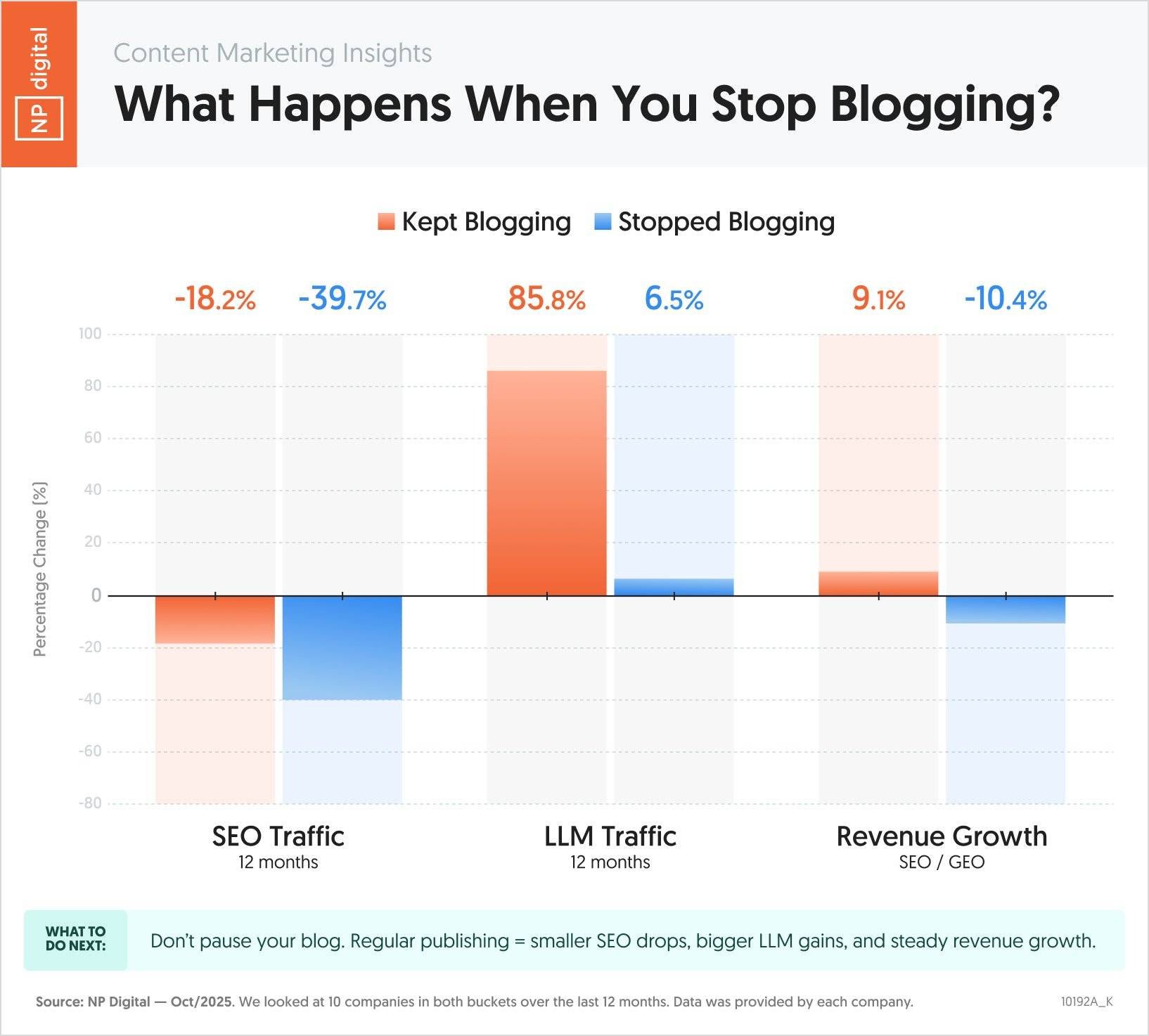
The research compares businesses that continued publishing helpful content with businesses that stopped. Over time, the companies that kept creating content experienced stronger search visibility, dramatically higher traffic from AI-powered search tools (LLM Traffic in the graph), and healthier long-term business growth.
Ironically, I didn't fully appreciate this until I started watching it happen in my own business.
What struck me wasn't the exact percentages, although they're impressive. It was confirmation of something I've been learning for my own online visibility and that of my clients: Visibility compounds.
Every helpful article gives Google (and increasingly AI Search) another opportunity to understand your expertise. Every page becomes another doorway into your business. No single piece has to do all the work because each piece supports the others.
Every newsletter strengthens the relationship you've already begun building. None of those things necessarily create immediate results on their own (although they can), but together they create momentum that's almost impossible to achieve through sporadic, disconnected marketing, what I call Random Acts of Marketing.
And that's one of the reasons I've stopped talking about individual marketing tactics so much and started talking about your Digital House Framework instead.
A blog isn't just a blog. It's content that supports your website, gives you something meaningful to share in your newsletter, creates material for social media, answers questions that AI can reference, and helps future customers discover your business months (or even years) after you publish it.
When everything connects, every piece becomes stronger.
Four Early Signs Your Visibility Is Growing
So if sales aren’t flowing in like a tsunami, what should you actually be looking at?
This is where I think many business owners miss an opportunity.
In addition to asking, "Did I book a discovery call this week? Or how many people registered for the webinar?" I encourage people to start paying attention to four much earlier signals. They're the indicators that tell you your visibility is growing, even before it turns into revenue. And hey, let’s find reasons to celebrate these quieter wins.
1. Is Google discovering more of your content?
If you've never looked at Google Search Console before, don't worry. It's a free tool from Google that shows you how your website is performing in search. You can see which pages have been indexed, what people are searching for, and how often your site is appearing in search results.
Don't worry about comparing your numbers to someone else's. Instead, compare your website to where it was three months ago. Are more pages being indexed? Are your impressions increasing? Are you appearing for more search terms?
Even if people aren't clicking yet, increased impressions are often one of the earliest signs that Google is beginning to understand what your website is about.
2. Are people engaging when they arrive?
Whether you're using Google Analytics or your website platform analytics, don't focus only on the total number of visitors.
Which pages are attracting people? How long are they staying? Are your blog articles becoming some of the most visited pages on your site?
Those trends tell a much richer story than a single month's traffic because they show you what people actually find valuable.
3. Are people staying connected?
Your email newsletter can tell you a lot.
Which topics are getting opened? Which links are people clicking? Are readers replying with questions or comments?
Those aren't just email metrics. They're signs that your content is resonating with the people you want to reach.
4. Are people taking the next step?
Sometimes the most valuable analytics aren't found in Google at all.
Listen for the comments that start to appear.
"I've been reading your articles."
"I found you through Google."
"I've been following your newsletter for a while."
"I asked ChatGPT about this, and your business came up."
Those moments often happen long before someone becomes a client, but they're some of the clearest indicators that your visibility is growing.
Your Visibility Dashboard
I've started thinking of these four areas as a simple Visibility Dashboard. Instead of obsessing over likes or wondering why one social media post didn't perform well, I can look at the bigger picture and ask:
Are more people discovering my business?
Are they engaging with what they find?
Are they staying connected?
Are they taking the next step?
When you look at your marketing this way, it becomes much easier to recognize (and celebrate) progress while it's happening, instead of waiting for a dramatic result to tell you everything is finally working.
Build Confidence Before the Results Become Obvious
One of the reasons I wanted to write this article is because I think too many business owners lose confidence right before their marketing begins to gain traction.
We compare ourselves to businesses that have been creating content for years. We judge ourselves by the latest reel’s likes, this month's sales, or this week’s registrations. When those things don't happen immediately, we assume we've failed.
What if we looked at other indicators?
Instead of looking only at the final outcome, start paying attention to the quieter signs of progress. Notice when Google indexes another page. Notice when your website begins appearing for new searches. Notice when someone replies to your newsletter or tells you they've been reading your articles for months.
Those are all signs that you're building something meaningful.
Visibility isn't just about being found. It's about building confidence that the work you're doing today is creating opportunities you'll benefit from tomorrow.
Start Measuring What Matters
That's why I encourage every business owner to establish a baseline before they commit to creating consistent content. Take a look at your website analytics. Open Google Search Console. Notice where you are today. Then, after three or six months of publishing thoughtful, connected content consistently, come back and compare your own progress. Not someone else's. Your own. I think you’ll be very pleased.
That's how you'll begin to recognize growth long before it feels obvious.
If you're wondering where to begin, start with the Digital House Assessment. In just a few minutes, you'll identify what's already supporting your visibility, where the gaps are, and which one improvement is most likely to make the biggest difference.
Because marketing works better when everything connects.
FAQs
-
Content marketing and SEO rarely produce overnight results. Instead, they build momentum over time. As Google indexes more of your content and AI gains a better understanding of your expertise, you'll often begin seeing increased search impressions, stronger website engagement, and more meaningful conversations before you notice a significant increase in leads or sales. The key is to measure your progress against where you were three or six months ago, not where someone else is today.
-
Marketing results often appear long before new clients or increased revenue. Look for early signs such as increased Google Search impressions, more pages being indexed, higher website engagement, stronger email performance, and conversations that begin with, "I've been following your work." These are all indicators that your visibility is growing.
-
Lagging indicators are the outcomes all business owners hope for, such as sales, inquiries, booked discovery calls, or new clients. While they're important, they're often the last signs to appear. Earlier indicators, like search visibility and website engagement, help you understand whether your marketing is moving in the right direction.
-
Google Search Console is a free tool from Google that shows how your website is performing in search results. It helps you see which pages Google has indexed, what people are searching for, how often your site appears in search, and where you have opportunities to improve your visibility.
-
Once a month is usually enough for most small business owners. Rather than watching your numbers every day, compare your progress over three to six months. Look for trends in website traffic, search impressions, popular pages, and visitor engagement instead of focusing on short-term fluctuations.
-
Social media is only one part of your marketing ecosystem. Your website, blog, email marketing, and search visibility all work together to help future clients discover your business. When these pieces are connected, your marketing continues working long after a social media post disappears.
If you’re tired of trying to keep up with algorithms and endless posting schedules, you’re not alone. Visibility doesn’t have to mean living on social media. There are simpler ways to stay top-of-mind with your audience that build trust, relationships, and long-term momentum. Read more here: How to Stay Visible Without Living on Social Media
-
It means your marketing shouldn't operate as separate activities. A blog post can strengthen your website, support your newsletter, provide social media content, improve SEO, and help AI understand your expertise. When each piece supports the others, your marketing becomes more effective and more sustainable.
Read more here: Your Marketing Isn't Broken. It’s Just Not Connected
-
Start by understanding where you are today. Review your website analytics, explore Google Search Console, and identify which parts of your Digital House are already supporting your business and where there are opportunities to improve. From there, focus on creating helpful, connected content consistently over time rather than trying to do everything at once.
In about 10–15 minutes, the Digital House Assessment will give you a clear snapshot of what's already supporting your visibility, where there are opportunities to strengthen your marketing, and which area deserves your attention first.
→ Get your Digital House in order with the Digital House Assessment